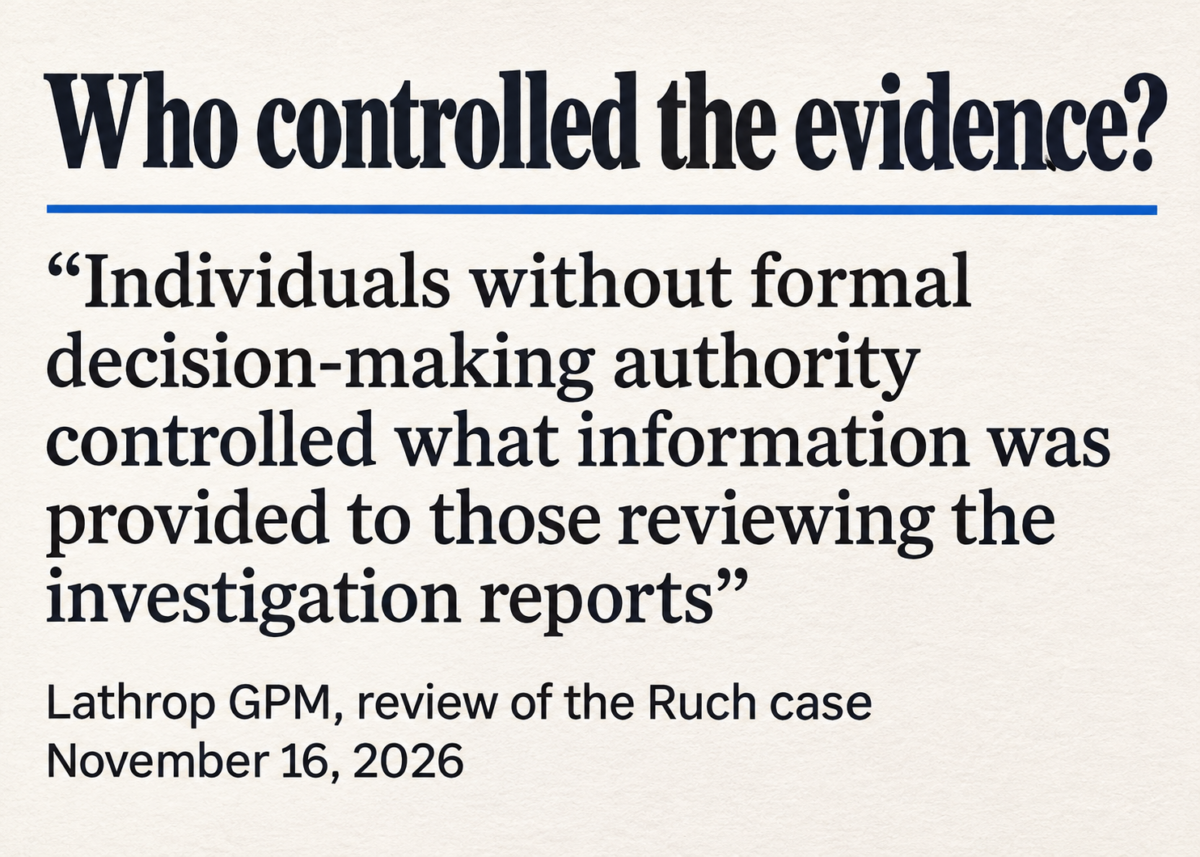
People who had no authority to decide whether Bishop Stewart Ruch III should face church charges controlled what information reached the people who did. At times, they also tried to influence the deliberations. That is the central finding in the four-page summary the Anglican Church in North America (ACNA) released November 18. Readers who want to know who exercised that influence are out of luck.
The case grew out of the 2019 disclosure that Mark Rivera, a lay catechist in the Diocese of the Upper Midwest, had sexually abused a child. A criminal court convicted Rivera in 2022. Ruch faced church charges over his leadership and handling of abuse allegations. On December 16, 2025, ACNA’s Court for the Trial of a Bishop unanimously acquitted him on all four charges.
Some witnesses had to tell their stories twice
The court had already identified a problem with the first set of charges. The three bishops who signed them lacked firsthand knowledge of the underlying facts, the court found, and none appeared to testify. The outside review by Lathrop GPM explains how little control the people weighing charges had over the information in front of them. Its assignment covered the province’s handling of the case before trial. The verdict stands.
ACNA hired two investigative firms and gave no one clear responsibility for supervising them. Their work overlapped, and some witnesses had to recount painful experiences more than once. When it came time to review the church’s own decisions, Lathrop interviewed 12 of the 20 people it contacted. Several with firsthand knowledge declined or set conditions the reviewers could not accept.
As Anglican Watch reported November 6, the province had promised the public a summary. In March, ACNA said the review would examine why members of its Provincial Response Team resigned and whether staff improperly shared case files with the court. The public summary gives no conclusion on either question.
Lathrop credits ACNA’s revised disciplinary canons, effective January 1, 2027, with clarifying the process. It also warns that so many people still get a say that different stages could produce conflicting decisions.
The Episcopal Church already has the rule
The Episcopal Church (TEC) has already tried writing a clearer rule. Under Canon IV.8.1, the diocesan bishop must arrange an appropriate pastoral response whenever a report reaches the intake officer. An allegation of sexual misconduct also requires a professional pastoral care assessment. All of that can happen while the facts are still in dispute.
Consider Trinity Episcopal Church in Upperville. The Episcopal Diocese of Virginia says its investigation found conduct inappropriate for a priest and that the Rev. Jonathan Adams returned to ministry under a disciplinary agreement. Its public account describes the pastoral support the bishop offered Trinity’s associate rector. The complainants told Anglican Watch the diocese offered them neither a pastoral response nor pastoral care.
Who holds the bishop to that duty? In a separate case, Anglican Watch published the written response of the Rev. Barbara Kempf, TEC’s intake officer for bishops. She concluded that the bishop’s alleged failure to provide a pastoral response did not constitute a Title IV offense in that case.
As we read Kempf’s response, her reasoning was circular. Because the bishop had never provided a pastoral response, she treated him as having no obligation to provide one. Yet under Canon IV.8.1, the duty arises when a report reaches the intake officer. On Kempf’s logic, the very omission the complainant reported becomes the bishop’s defense.
We have a question for each church. In ACNA, who controlled what the people weighing charges got to see? In Virginia, who contacted the complainants, and when? Neither question seems to require another committee.
Sources
- Lathrop GPM’s executive summary and ACNA’s original terms for the review show what the province asked and what the reviewers disclosed.
- The court’s final order explains the acquittal and its findings about the bishops who signed the first charges.
- TEC’s 2024 amendment to Canon IV.8.1 sets out the bishop’s obligations at intake.
- Virginia’s public account and Anglican Watch’s interviews with complainants describe who was offered support in Upperville.
- Anglican Watch’s reporting on enforcement reproduces the intake officer’s written response in a separate complaint against a bishop.