
The United Methodist Church (UMC) has acknowledged that survivors of sexual misconduct continue to face delayed responses and dismissed complaints, despite the denomination’s formal apology for decades of institutional failures. The admission is welcome. Whether anything changes is another question.
More than 900 people attended the denomination’s November 12–14 Do No Harm conference, organized by its General Commission on the Status and Role of Women. The gathering focused on preventing sexual misconduct, improving institutional responses and providing trauma-informed care.
According to United Methodist News, the Rev. Tyler Schwaller, the denomination’s director of sexual ethics, described survivors waiting weeks for responses and seeing complaints dismissed despite substantial evidence.
In other words, the church has policies, procedures, training and conferences. What it apparently doesn’t always have is accountability.
An apology is not reform
In 2024, the UMC formally apologized for protecting its institutional interests at the expense of survivors. Church leaders acknowledged that misconduct had been ignored, survivors disbelieved and institutional procedures used to shield alleged offenders from accountability.
The apology included commitments to improve education, provide healing resources and develop trauma-informed complaint procedures. Two years later, the denomination is still hearing about familiar failures.
To its credit, UMC officials are publicly acknowledging those failures rather than pretending that a revised policy manual solves everything. The Rev. Stephanie York Arnold, who leads the commission, was especially direct, acknowledging that churches have sometimes permitted abuse to be committed, tolerated or concealed. She said the objective must be changing the conditions that allow harm to continue.
We agree. And the measure of success isn’t another conference. It’s what happens when someone reports misconduct.
Sound familiar, Episcopalians?
For readers familiar with the Episcopal Church’s Title IV disciplinary system, the parallels are difficult to miss. Survivors encounter bureaucratic delays, inadequate communication, institutional defensiveness and processes that can appear more concerned with protecting church leadership than addressing misconduct.
Indeed, many Episcopal dioceses, including Florida and Virginia, routinely ignore what is one of Title IV’s most basic requirements: providing a pastoral response whenever a complaint is made to an intake officer.
Canon IV.8.1 is unequivocal: “The Bishop Diocesan shall provide for appropriate pastoral response whenever any report is made to the Intake Officer.” Not when a complaint is substantiated. Not when an investigation begins. Not when the bishop finds it convenient. Whenever a report is made.
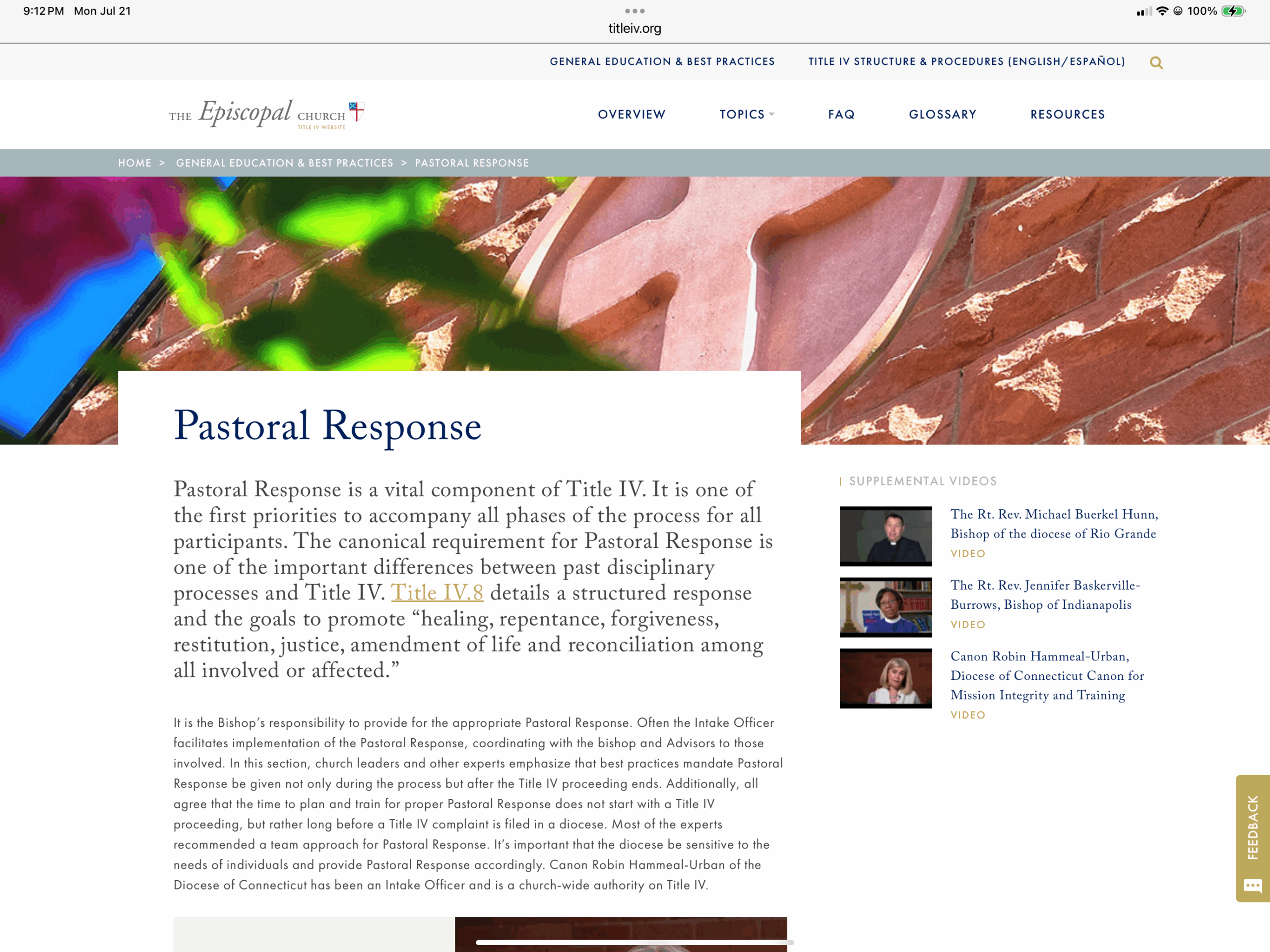
The requirement is hardly obscure. As the Episcopal Church’s former Title IV website made clear in its explanation of pastoral response, a pastoral response is required in all cases. Apparently, some dioceses missed the memo.
Yet Anglican Watch has documented cases in which complainants receive no meaningful pastoral response whatsoever. In Florida and Virginia, our concerns extend beyond how complaints are investigated to whether diocesan leaders comply with this elementary requirement in the first place.
And pastoral response is not synonymous with pastoral care. The former is the broader canonical obligation to address the needs of affected persons and communities; the latter is one component of that response. Canon IV.8.2 requires consideration of pastoral care for complainants, respondents, their families, injured persons, witnesses and others affected. Our guide to pastoral response explains how dioceses can meet those obligations.
Both denominations have extensive disciplinary provisions. Both profess concern for survivors. Both have devoted considerable attention to improving their processes. Yet the fundamental question remains: What happens when church officials themselves fail to follow those processes?
Training is useful. Independent oversight, enforceable deadlines, transparency and meaningful consequences for institutional failures are better. Our comparison of mainline clergy disciplinary systems identifies several ways to strengthen accountability.
Time to measure results
The UMC deserves credit for acknowledging its shortcomings. But its leaders should now provide measurable answers:
- How many misconduct complaints are received annually, and how long does resolution take?
- How often are complaints dismissed, and on what grounds?
- What independent review is available when church authorities mishandle allegations?
- What consequences do bishops and other officials face for failing to respond appropriately?
- How does the denomination measure whether survivors actually receive the pastoral support and care they need?
Until those answers are available, assurances of reform remain difficult to evaluate. For the UMC, Do No Harm is more than a useful Methodist slogan. It’s a standard by which the denomination should be judged. And for survivors, another apology without meaningful accountability risks becoming one more injury.
Related coverage
- What other churches can teach TEC about clergy discipline
- Clergy misconduct: PCUSA offers a second look. The Episcopal Church should, too.
- Pastoral response that actually helps
Sources
- United Methodist News — Do No Harm helps church address misconduct. November 18, 2026, conference reporting and denominational leaders’ descriptions of delays and dismissed complaints.
- United Methodist Church — Apology to survivors. The denomination’s 2024 statement acknowledging institutional failures and committing to reform.
- United Methodist Church — Complaint process. Official information on sexual misconduct complaints.
- Episcopal Church — Constitution and Canons. Title IV pastoral-response and pastoral-care obligations.
- Former Title IV website — Pastoral response screenshot. Archival screenshot explaining that pastoral response is required in every case.