

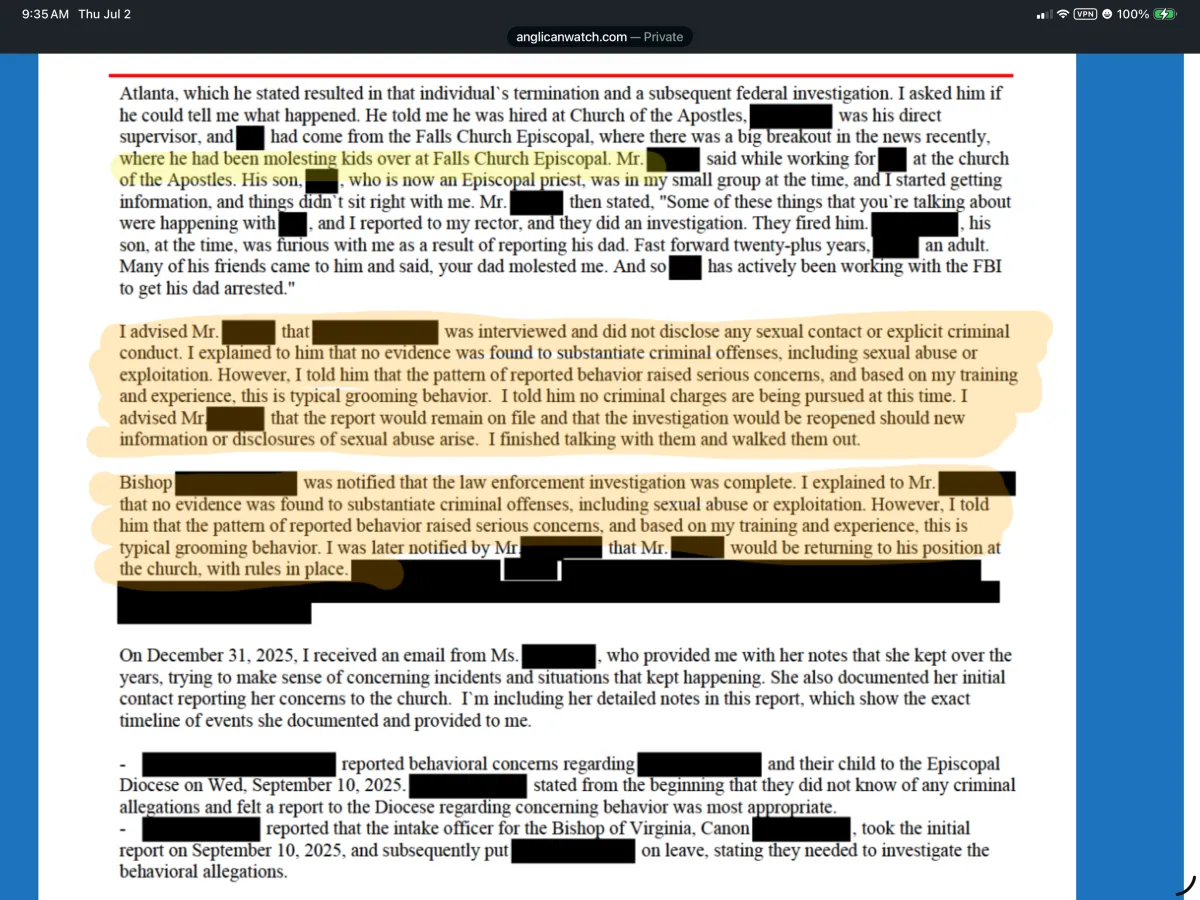
The Episcopal Diocese of Virginia’s public account of the Jonathan Adams case omits a critical safeguarding concern: a sheriff’s detective described the reported conduct as “typical grooming behavior.” An organization relying on that account, or information outlined in the Notice of Accord, would not learn of that assessment—or the specific directions imposed when the diocese allowed him to return to ministry.
Adams has left Trinity Episcopal Church in Upperville. The unanswered questions have not. If the reported conduct occurred—and we believe it did—the diocese’s silence may put children at risk by leaving a future employer without the information needed to protect them.
What would a future employer learn?
The diocese’s public account says its investigation found conduct inappropriate for a member of the clergy. Adams returned to work in November 2025 under an Accord containing directions for his future ministry. The diocese has not disclosed specifics.
Tellingly, the account identifies possible misconduct involving children, but omits the detective’s description of the reported conduct as “typical grooming behavior.” A generic reference to inappropriate behavior is not, in our view, enough to ensure children’s safety.
Indeed, a prospective employer should not have to reconstruct a safeguarding history from news coverage and public-records requests. The detective’s assessment was not a criminal conviction, but it remains relevant to anyone considering giving Adams access to children. And just in case anyone has any doubt on that score, we would not trust Adams with a $10 bill, let alone the welfare of a child.
The bishop can disclose more
Bishop Mark Stevenson has explicit authority to disclose details. Canon IV.8.3 permits a bishop to disclose information about an alleged offense, Accord, or Order as the bishop considers pastorally appropriate, notwithstanding contrary provisions elsewhere in Title IV. Canon IV.8.4 requires consideration of affected persons’ privacy and pastoral needs.
Separately, Canon IV.14.14 prohibits an Accord or civil settlement from restricting disclosure of factual information about an alleged offense. It permits protection of an alleged injured person’s identity and settlement amounts.
Thus, because we’re talking about the welfare of children, we can think of no legitimate justification to conceal the specifics of the allegations against Adams.
Anglican Watch considers the allegations credible. If the reported conduct occurred—and we absolutely believe it did—withholding the details may leave another congregation—or another organization employing Adams—unaware of the concerns before entrusting children to his care.
An Accord is not exoneration
The church office’s statement that Adams had been “exonerated” conflicts with the diocese’s own account. Its investigator found inappropriate conduct, and his return carried conditions. Neither amounts to exoneration.
Stevenson’s July letter attributed some of the continuing distress to bloggers and social media. But the underlying facts did not originate with a blog. Anglican Watch obtained the sheriff’s 23-page investigative report through a public-records request and interviewed people with direct knowledge of events.
The bishop’s letter discussed child protection in general terms. It offered no comparable acknowledgment of the particular children and families who reported the conduct. Meanwhile, neither the congregation nor the individuals affected by Adams’ behavior were told the terms governing its rector’s return.
Generic assurances about safeguarding are easy. Providing information that helps people protect children is the actual work.
Questions from Atlanta
We also need to remind readers of the curious silence coming from Atlanta. Specifically, we have questions about Adams’ earlier employment at Church of the Apostles in Atlanta. Adams claims the church terminated him for violating a nondisclosure agreement concerning an accused child sex offender who worked there. Yet the church has not responded to Anglican Watch’s requests to confirm his account.
Let’s be clear: Since Adams himself has shared this information, there is no reason why Apostles can’t, or shouldn’t, confirm or refute Adams’ claims.
Meanwhile, people who worked with Adams at Apostles tell Anglican Watch they believe he engaged in inappropriate behavior with boys during his employment there. So far, we have been unable to verify these allegations, but we find them plausible.
These allegations only add to our belief that Adams’ alleged misconduct is part of an ongoing pattern and practice of inappropriate conduct involving boys.
Birthday wishes and institutional amnesia
Relatedly, we are uncomfortable with the volume of birthday greetings on Adams’ Facebook page, given the seriousness of the underlying allegations.
On this score, we’re going to make something absolutely clear: We are not friends with anyone who is the subject of credible allegations of misconduct involving minors. And we never will be. We also question the judgment and integrity of anyone who can overlook these allegations.
That said, in our view, part of the problem rests with the diocese and its lack of disclosure. Specifically, when, as here, church leaders discuss allegations of grooming in vague terms, parishioners, already inclined to give a seemingly narcissistic priest a pass, are empowered to treat the underlying disciplinary matter as an unfortunate misunderstanding.
In other words, the continuing adulation and clericalism are appalling.
What should happen now
- The diocese should disclose the reported conduct, the findings of its (painfully thin) investigation, and the directions governing Adams’ return to ministry, while protecting the identities of children.
- Stevenson should explain what information the diocese will provide to prospective employers and receiving church authorities.
- Any account provided to a hiring organization should include the detective’s grooming assessment and the actual outcomes of the investigations.
- Trinity’s leadership should correct the claim of exoneration and explain what safeguarding measures accompanied Adams’ return. As things stand, Trinity’s wardens and vestry are complicit in Adams’ cover-up efforts.
- The Church of the Apostles should respond to questions about Adams’ departure and the allegations concerning his conduct there.
- Church leaders should preserve relevant records and provide a clear way for people with additional information or concerns to report it.
Adams’ departure does not resolve the safeguarding questions. The diocese should stop leaving others to discover what its public account leaves out.
Sources
- Anglican Watch: Reporting on Adams’ resignation and the sheriff’s investigation.
- Diocese of Virginia: In the Matter of the Rev. Jonathan Adams and Trinity Church Upperville, including Stevenson’s July 17, 2026, letter.
- Diocese of Virginia: Notice of Accord.
- Episcopal Church Constitution and Canons, 2024: Canons IV.8.3–4 and IV.14.14.
- Church of the Apostles, Atlanta: institutional website.
- Adams’ Facebook page: birthday greetings.
- Fauquier County Sheriff’s Office investigative report obtained by Anglican Watch: published excerpt containing the detective’s grooming assessment.
- Anglican Watch interviews with people who worked with Adams at Church of the Apostles and others with direct knowledge; reporting that Adams asked children to call him “Johnny Boy,” his account of his departure from Apostles, and requests to Apostles for confirmation.



When you get frustrated at the lack of response from church leadership and its members, I think it is important to remember how sticky religious beliefs and behaviors can be. Many of the leaders, clergy, and adult members have spent their lives supporting and defending the church.
It is almost impossible to change people’s minds short of a lawsuit that causes enough financial harm to make them rethink their position. To them, the Anglican Watch is a bunch of muck-raking apostates…
In my experience, older people are willing to ‘weather the temporary storm’ while younger people vote with their feet. Some metrics worth watching include the number of confirmation students in a church and the ratio of people 18-30 to total membership.
I expect that Trinity Episcopal Church will weather this storm in the short term by battening down the hatches.
A lot of kids will have a pretty good idea what is really happening at Trinity… and they are scratching their heads as their parents defend Adams just because he is a church leader. The price will be paid as the next generation comes of age to make their own decisions and decides that Trinity Episcopal Church, the Episcopal Church, and often Christianity are not for them.
Sadly, the current generation of leadership will be long gone and never face the consequences of their selfish decisions.