
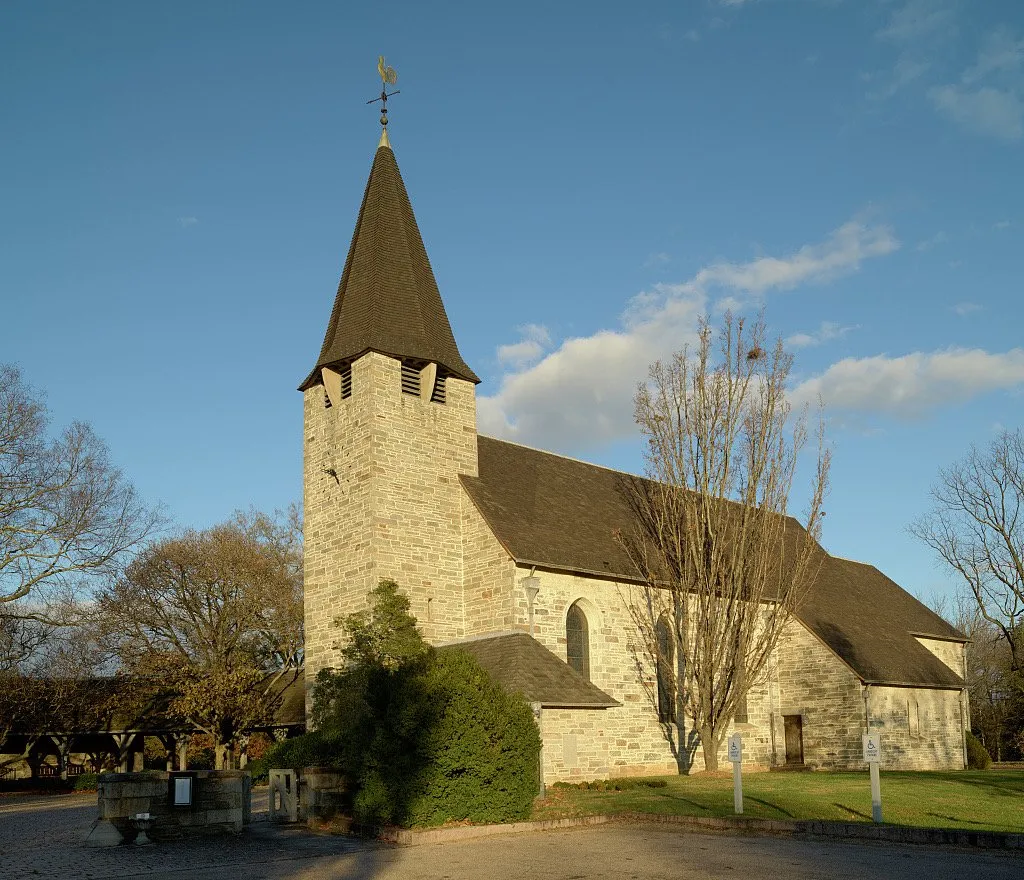
We’re calling BS: parsing Episcopal priest Jonathan “Johnny Boy” Adams’ denials as he goes on sabbatical
Multiple sources within the parish of Trinity Upperville have told Anglican Watch that, in response to our recent coverage of allegations that he has engaged in grooming behavior, rector Jonathan “Johnny Boy” Adams has gone on sabbatical. In doing so, Johnny Boy has made various claims that he was cleared of wrongdoing by the Diocese and that he never engaged in the alleged behavior.
This post parses these claims and provides additional context. And, to be clear, we do not believe Johnny Boy’s denials. Not for an instant.
On intra-church dynamics, or the importance of not acting like a bunch of asses
Before we go further:
We are aware of hateful and ugly behavior coming from within the parish in response to these allegations. Three things:
- We have multiple sources for our coverage, and several have no meaningful contact with each other.
- People who come forward in these situations invariably do so fully aware of the shunning and ostracism that will follow.
- As we have stated previously, the rate of inaccurate reporting of child abuse is vanishingly low.
For these reasons, it’s important to believe those with the courage and integrity to come forward. It’s even more important not to retaliate when they do.
As to those jackasses at Trinity who are blaming specific individuals and behaving badly towards them, all we can say is, “Time to grow up.”
No one person is the source of our coverage. Moreover, the welfare of children is far more important than your precious bruised snowflake feelings. And your hateful conduct only reinforces the accuracy of the comment by the late Bishop Barbara Harris, the Episcopal bishop who famously said,
Nobody can hate like Christians.
Further, as a practical matter, the behavior of these individuals and their ad hominem attacks only serves to discourage people from any role in the collective life of Trinity Upperville.
So, stop acting like asses, people. It’s not a good look, and if you continue, we will name names. Try us.
About the police investigation and report
Next, we need to examine the police investigation/report and assess its probative value.
As the police report makes clear, law enforcement officials interviewed multiple sources, including Johnny Boy himself, during the investigation.
The detective assigned to the case correlated the results of these interviews with independent evidence, including cell phone records.
The investigatory report also states that, upon the conclusion of the investigation, the detective, Candyce Shaw, met with Johnny Boy and told him that, while he didn’t appear to have violated any laws, she had concluded that his conduct was consistent with that of grooming. (Regrettably, Virginia has not yet joined the growing list of states that have made grooming behavior a criminal offense.)
 Detective Candyce Shaw investigated allegations of grooming against “Johnny Boy” Adams
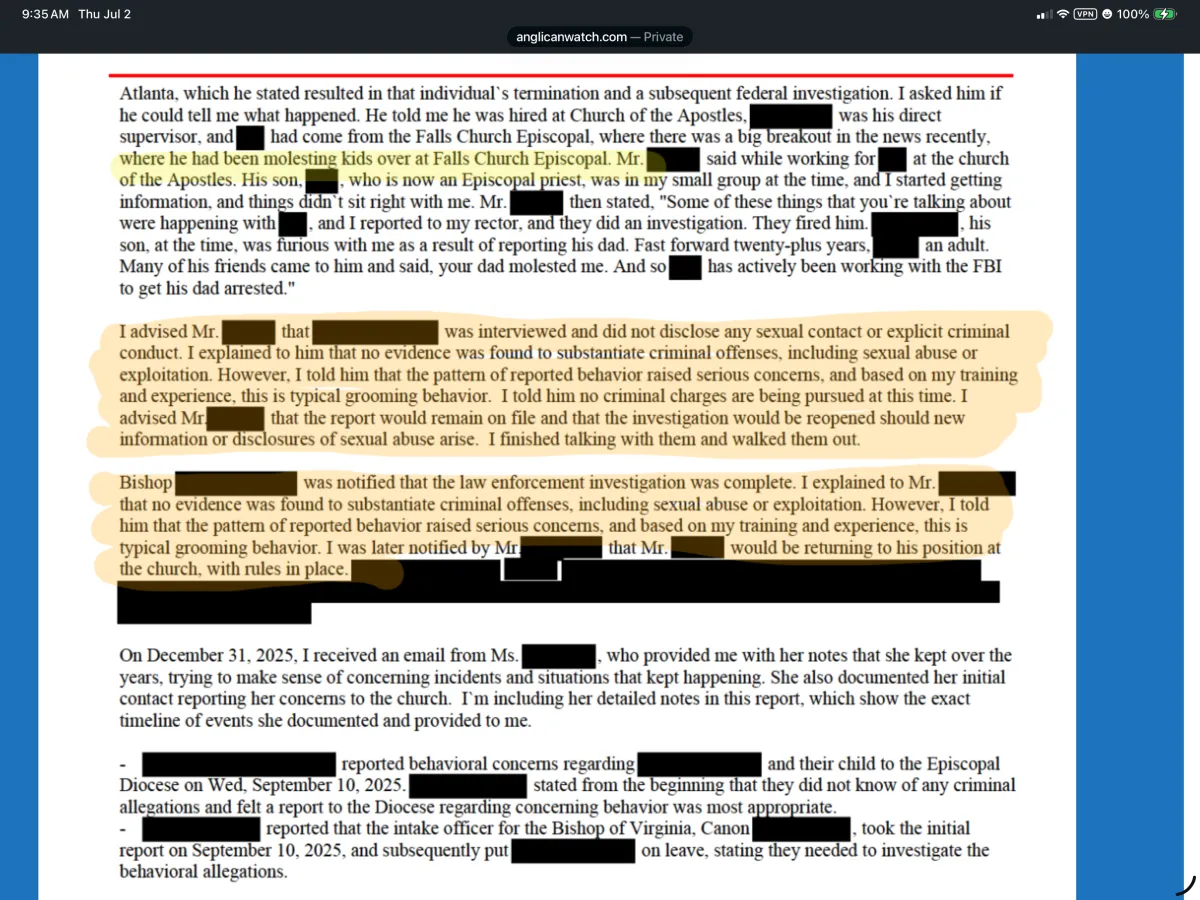 Here are Detective Shaw’s written conclusions that “Johnny Boy” Adams engaged in grooming, Hardly exculpatory, despite Adams’ claims to the contrary.
This is a far cry from Johnny Boy’s claims that he was exonerated.
As to his assertions that the Diocese conducted its own investigation, nothing of the sort happened.
Moreover, had there been a Diocesan investigation, it would, by definition, carry less probative value than a police investigation, for it is famously difficult for churches to investigate their own behavior.
This brings us back to assertions from within Trinity that one person, or a handful of persons, created this situation as a vendetta against the current rector.
For this to happen, multiple independent sources would have had to collaborate behind the scenes, trick the police, and then bolster their fabrications with falsified independent evidence, like the cell phone records that police accessed during their investigation (these were obtained directly from the relevant cell phone provider).
In other words, doing so would have required a far-reaching conspiracy, and that simply didn’t happen.
Our independent investigation of this situation
Relatedly, as we have previously stated, we did not rely solely on the police investigatory report to reach our conclusion that Johnny Boy did, in fact, engage in grooming conduct. Instead, we:
- Interviewed multiple first- and second-hand sources.
- Sent out FOIA requests.
- Ran a background check on Johnny Boy.
- Contacted persons at the Church of the Apostles, where Johnny Boy previously worked.
- Interviewed area residents who know the family.
- Spoke with teachers.
And much more. We even explored ancillary issues, like information on the family’s alcohol consumption, travels, and other details not immediately relevant to the issues at hand.
All of the information we have obtained supports the allegations in question. None refutes the allegations.
Additional issue: plausibility
There is another wrinkle in all of this: the allegations are plausible in a way that is inconsistent with some crazy conspiracy theory that alleges one or more persons are out to get Johnny Boy.
Anglican Watch has considerable in-house expertise on these issues. Additionally, we have access to two mental health professionals with expertise in grooming and child sexual abuse.
Thus, we can say with confidence that the allegations we have received are not only credible, but they also contain the sort of details that would be all but impossible for someone to make up. Add in the fact that these details are consistent across sources, and we see zero possibility that they are false.
The role of the Diocese
We’ve touched on this topic in our previous coverage, but the Diocese of Virginia’s role in this matter is both difficult to assess and troubling.
Specifically, we have long been aware that the Diocese prefers to handle matters behind the scenes whenever possible to protect the institution and avoid public disclosure, all in the name of protecting church members from trauma.
These behaviors, of course, sound suspiciously like protecting the institution, à la the Roman church, circa fifty years ago. And we all know how that worked out.
Relatedly, the Title IV clergy disciplinary canons’ confidentiality provisions play a role in this.
Instead of recognizing the fact that we cannot be in right relationship with one another when we don’t know the truth, and thus making the pastoral decision to disclose allegations of misconduct (which is expressly authorized in the canons), the Diocese likes to treat everything as hush-hush, perhaps out of a misplaced fear of liability for defamation or other alleged tortious conduct.
As a result, toxic patterns of behavior become skeletons in the closet, causing lasting harm to parishes and people, often for decades to come.
The tiny size of the Episcopal Church, now under 1.5 million members and falling fast, further exacerbates this situation.
Indeed, no one in the church enjoys 6 degrees of separation; instead, they enjoy 3 degrees of separation, and that only on a good day. As a result, there are few secrets in the church, and sooner or later, word of alleged clergy misconduct invariably gets around.
Thus, the Diocese of Virginia does no one any favors when, as here, it tries to cover-up or paper over problems.
Further, clergy like Johnny Boy like to hide behind this veil of secrecy, and we’re prepared to bet he is telling people, “There are aspects of the earlier Title IV case I can’t share with you,” even as he tells church members that he was found innocent. If he is, indeed, innocent, then it’s time to get permission from the bishop diocesan to produce evidence to support this claim.
Of course, that begs the issue: If Johnny Boy came out of this fully exonerated, why did the Diocese impose restrictions on him, including that he cannot be alone with children not his own? Imposing restrictions, even as ludicrously thin as the ones in this case, is not something a bishop does if they think the priest in question is squeaky clean.
We also need to invoke the adage about Caesar’s wife needing to be above reproach. Specifically, a priest whose behavior is appropriate has, by definition, acted in a way that no one can question his conduct. And we cannot fathom a situation in which, in this day and age, a priest has ANY child sleep over at his home.
Indeed, it is undisputed that Johnny Boy has repeatedly invited children to sleep over at his home, which is a per se violation of the safe church requirement that children be accompanied by two unrelated adults at all times.
Thus, we are left asking: Who exactly is the second unrelated adult at these sleepovers at Johnny Boy’s home?
This situation is even more disturbing in light of Johnny Boy’s connection to the child sexual abuse scandal at the Falls Church Episcopal. Are we really to believe that, even after getting up close and personal with a major child sex abuse scandal, Johnny Boy doesn’t recognize the importance of not doing anything even remotely questionable? Indeed, if he hasn’t figured that one out, he is, by definition, too damned dumb to be a priest. And the Diocese should have recognized this long ago.
Relatedly, we are troubled by the seeming lack of a pastoral response from the Diocese to those affected by these allegations. (Under the canons, a pastoral response is NOT the same as pastoral care, although the latter may be part of the response.)
Specifically, the alleged grooming is likely profoundly harmful to multiple people, including members of Trinity Upperville, who now may feel the need to take sides in this matter.
Meanwhile, we see people at Trinity acting like asses over these issues, yet the Diocese does not appear to be doing anything to provide spiritual guidance or leadership. In fact, news of Johnny Boy’s sabbatical should have come from the Diocese, rather than from Johnny Boy himself. Yet it appears that the latter broke the news to the parish.
Relatedly, we urge parishioners to learn about the importance of disclosure in the context of alleged wrongdoing. In that regard, we wholeheartedly endorse the Rev. Canon Robin Hammeal-Urban’s excellent book, “Wholeness After Betrayal: Restoring Trust in the Wake of Misconduct.” Available through Amazon in paperback, it’s also available as a Nook electronic book. Pay particular attention to the discussion of the Alban Institute’s four-tiered model of disclosure, which comprises disclosure at the following levels:
- Interpersonal
- Intra-personal
- Organizational
- Social
So, where are we now?
As things stand, we are confident that Johnny Boy is lying to his parish by claiming he was exonerated. Certainly, law enforcement did not exonerate him, and when it comes to credibility, our money is on law enforcement, hands down.
As to Johnny Boy’s sabbatical, hopefully it is a precursor to his resignation from ministry. Indeed, even if we consider the facts most favorable to Johnny Boy, he still evinces a lack of judgment categorically inconsistent with being a priest. (Recall his termination from Church of the Apostles, allegedly for breaching a non-disclosure agreement about — you guessed it — child sexual abuse.)
Meanwhile, there is an urgent need for the Diocese of Virginia to put boots on the ground at Trinity Upperville to provide leadership amid this hot mess. Further, it is vital that the Diocese and the parish (including its wardens) not be seen as protecting a potential pedophile.
And we remind all involved: One of the parties that should have received a pastoral response in the course of the earlier Title IV clergy disciplinary case against Johnny Boy was none other than the parish itself. By ignoring this requirement, the Diocese set all involved up for the current meltdown.
To be clear: This situation is not going away any time soon. We are nothing if not tenacious, and we are continuing to investigate this situation. As a result, we believe we will have additional information to publish in the coming days.
Disclosure: Anglican Watch editor Eric Bonetti had no role in preparing this post due to a potential conflict of interest.
As a Trinity parishioner, I can tell you that you’re spot on and I applaud your efforts. Jonathan is a narcissist and he surrounds him with loyalists and sycophants in order to protect himself.
One of the worst is Senior Warden Scott Andrews, who fawns all over Jonathan and blindly protects him; he couldn’t care less that Jonathan is apparently a pedophile. Andrews also has made inappropriate and unhelpful remarks about this situation that are proving damaging to the parish and the reputations of others. As a result, I’m putting 50/50 odds that he gets sued for defamation.
Of course, all of this is largely due to the Diocese and its dismal handling of this situation. The instant law enforcement told +Stevenson that they believed Jonathan was grooming boys was the moment Jonathan should have been gone.
Meanwhile, people wonder why we never bring our grandchildren to church. The answer is this it is not a safe place, even just in terms of the behavior of people like Andrews. Specifically, I don’t want the children to grow up thinking it’s okay to ignore others in distress, to brush off boundary violations, or to trash the reputation of others who have the integrity to come forward.
Finally, people need to understand that, much like Jonathan, Trinity is a narcissistic construct, where people think they’re somehow special because most of us live in hunt country and are affluent. But without kindness, decency, compassion, and integrity, none of this matters. Meanwhile, I see zero empathy or compassion for the boy who was the subject of Jonathan’s attentions or the boy’s family.