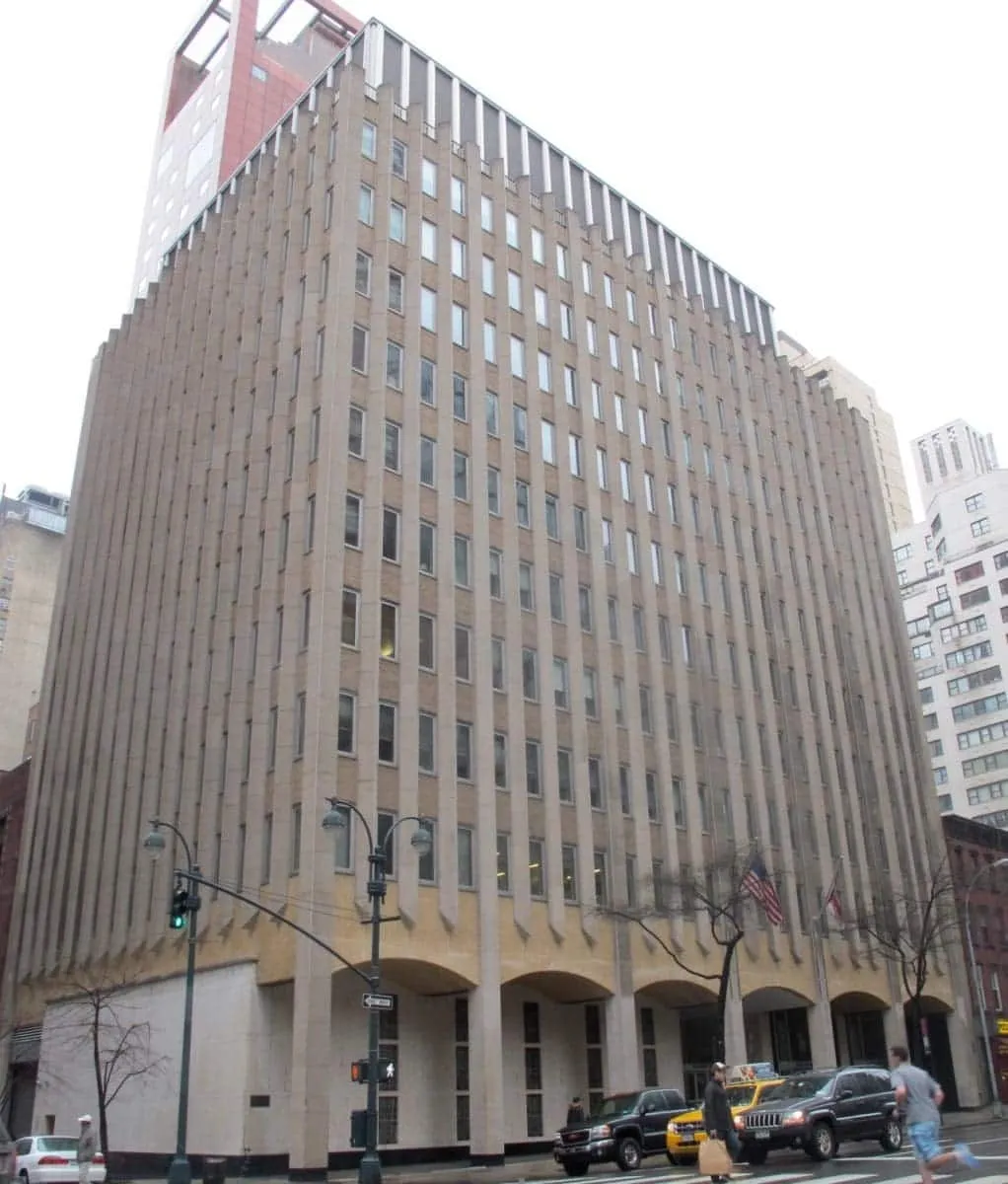
The Episcopal Church has found a buyer for its Manhattan headquarters at 815 Second Avenue. The building is under contract, the buyer has been identified, and the church is finally moving toward unloading a property it should have sold years ago. But two important financial questions remain: What’s the price, and how much of the old renovation debt is still outstanding?
According to a November 12 report in Commercial Observer, New York-based CSC Real Estate has contracted to purchase the 12-story Episcopal Church Center. A company spokesperson confirmed the pending transaction.
Neither the purchase price nor the buyer’s redevelopment plans have been disclosed. The sale has not yet closed.
Apparently, transparency in church real estate has its limits.
A buyer with redevelopment experience
CSC specializes in redeveloping commercial properties, including office-to-residential conversions.
The firm is converting nearby 770 Second Avenue into 140 apartments, including 35 affordable units. That project secured $108 million in construction financing earlier this year.
The Episcopal headquarters, a 146,000-square-foot building at Second Avenue and East 43rd Street, could be another conversion candidate.
But CSC has announced no specific plans for the property, and there is no confirmed commitment to affordable housing.
Fourteen years of expensive discernment
The transaction follows an October 19 decision by Executive Council authorizing negotiations with a prospective buyer.
This is hardly a revolutionary idea. General Convention voted in 2012 to pursue moving church headquarters out of the building.
Then, for fourteen years, remarkably little happened.
According to Episcopal News Service, Chief Financial Officer Christopher Lacovara estimates that selling the building following the 2012 resolution, investing the proceeds and avoiding subsequent operating losses would have left the church with approximately $85 million more than it has today.
That’s a retrospective estimate, not an actual $85 million loss. Nevertheless, it raises serious questions about institutional inertia.
Fourteen years of delay. An estimated $85 million in foregone financial resources.
Apparently, discernment can be expensive.
And what about the renovation debt?
There’s another financial question: What happened to the borrowing associated with renovating and financing 815 Second Avenue?
The church’s 2023 audited financial statements reported $17.84 million outstanding under a successor financing arrangement with U.S. Bank. The loan was originally obtained in 2011 and subsequently restructured.
The audit showed approximately $16.36 million in principal remaining in January 2024, with the balance scheduled for repayment by January 2026.
The original renovations predated that borrowing, and the loan also served broader church financial purposes. It should not be characterized as an outstanding loan directly from the endowment without further documentation.
What remains unclear is whether the debt was fully repaid, refinanced or otherwise extinguished. The latest repayment status has not been independently established.
If money remains owed, the church must explain how that obligation will be satisfied and whether sale proceeds will be used.
The financing was restructured as unsecured debt, so repayment would not necessarily be a condition of closing the property sale. But any outstanding liability still affects the transaction’s overall financial benefit.
Before celebrating the proceeds, it would be helpful to know how much money the church owes.
Where will the sale proceeds go?
Under Executive Council’s October resolution, net proceeds will be allocated as follows:
- 75% to a trust whose income will fund church planting, congregational revitalization and redevelopment.
- 25% to a trust supporting temporary offices, relocation expenses and an eventual permanent headquarters.
Presiding Bishop Sean Rowe has made the sale central to his strategic plan.
That’s sensible. Maintaining an increasingly underused Manhattan office building while congregations struggle financially is hardly compelling stewardship.
But the proceeds available for ministry depend on the purchase price, transaction costs, outstanding obligations and relocation expenses.
Until those figures are disclosed, Episcopalians cannot meaningfully evaluate the financial benefits of the deal.
Questions the church needs to answer
Before the transaction closes, church leaders should explain:
- What’s the sale price? How does it compare with independent appraisals and competing offers?
- What happened to the old debt? Was the U.S. Bank term loan fully repaid in January 2026? If not, what remains outstanding, and how will it be satisfied?
- What are the actual net proceeds? How much will commissions, legal fees, closing expenses and other obligations consume?
- How much will relocation cost? What are the projected expenses for temporary offices and an eventual permanent headquarters?
- Who oversees the proceeds? What controls will govern investment decisions, distributions and congregational grants?
- What happens to the building? Does CSC anticipate residential conversion, affordable housing or another use?
These aren’t unreasonable questions. They involve one of the denomination’s most significant assets and the future of its congregational revitalization program.
Episcopalians shouldn’t need to play detective to understand the transaction.
Selling the building is the easy part
To Rowe’s credit, his administration is finally doing what church leaders contemplated for decades: disposing of an expensive, underused headquarters and redirecting resources toward congregational ministry.
That’s progress.
But the real test comes after closing. Will the proceeds strengthen struggling congregations, support church planting and help reverse years of institutional decline? Or will they disappear into another collection of committees, consultants and strategic initiatives?
The sale remains pending. The purchase price is undisclosed. And questions remain about the status of the old financing.
After fourteen years of delay, Episcopalians deserve a complete accounting of what the church is selling, what it still owes and what it will actually receive.
Finding a buyer is a start. Knowing how much money is left after the bills are paid would be even better.
Sources
- Commercial Observer, November 12, 2026: CSC Real Estate in contract to buy Episcopal Church headquarters
- Episcopal News Service, October 19, 2026: Executive Council authorizes headquarters sale negotiations
- Episcopal Church: Executive Council adopts strategic plan and authorizes headquarters sale
- Episcopal Church: 2023 audited financial statements, Note 7
- Episcopal Church: 2024 audited financial statements
- Episcopal Church: Financial statements and audit reports
- Commercial Observer: CSC’s 770 Second Avenue residential conversion