
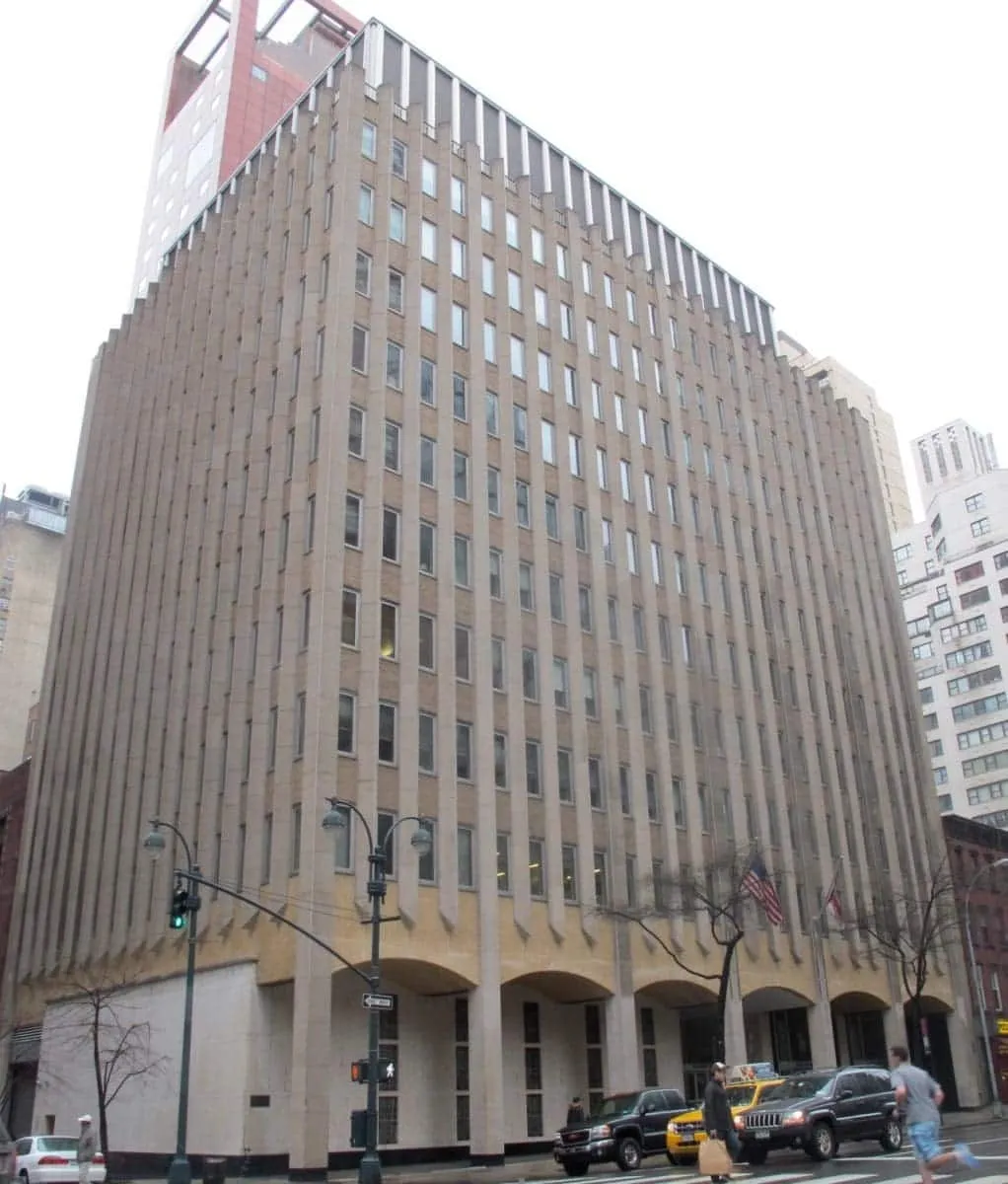
Finally: Episcopal church (may) be taking steps to offload its headquarters
According to a recent statement from Presiding Bishop Sean Rowe’s office, the Episcopal Church may finally be planning to sell its headquarters building at 815 Second Avenue in Manhattan. The move follows a 2012 resolution passed by the denomination’s General Convention that authorized the relocation of the church’s headquarters but not the sale of the property. The potential sale of the building has been under discussion for decades.
In recent years, large swathes of the building, known by many as “815,” have been leased to other organizations. Even with this rental income, however, the building costs roughly $4 million annually to operate. (Some of this rental income is reportedly illusory, comprising rent paid by Episcopal entities to the Domestic and Foreign Missionary Society, the Episcopal Church’s corporate entity that owns the building.)
Built in 1963, the 12-story building replaces the denomination’s former headquarters building, built in a Beaux Arts style and located at 281 Park Avenue South, Manhattan. The previous headquarters building is now commercial real estate.
In addition to office space, the current building includes a penthouse-level apartment for the denomination’s presiding bishop. The apartment has, however, been rarely used in recent years, even as an increasing percentage of church employees work remotely.
The 815 location underwent an extensive renovation in 2004, including asbestos remediation, HVAC system replacement, and fireproofing. The denomination financed the $29.9 million project via a loan from existing church investments.
Despite these renovations, the building remains underused and energy-inefficient, and is located in an area with some of the highest costs of living in the continental US.
Per the church’s recent announcement, the denomination hopes to negotiate a ground lease for the property. Under such an arrangement, a developer would lease the underlying land from the church for an extended period, then redevelop the property, ideally for affordable housing.
Potential benefits of sale/lease
As this publication has often stated, offloading church headquarters makes sense. In addition to the remarkably high carrying costs, the building does little to further the church’s mission at a time when corporate teams often work at distributed locations worldwide, relying on videoconferencing, email, and other technologies to avoid in-person travel and meetings.
Additionally, a sale could be a precursor to a more environmentally friendly and cost-effective approach to church meetings. As things stand, as many as 10,000 people travel, often by jet, to the triennial Episcopal General Convention, generating revenue for the host city ranging from $10 million to $23 million. Additionally, executive committee and house of bishops’ meetings are often in-person events, resulting in enormous costs to persons and dioceses that participate, as well as an extensive carbon footprint.
Moreover, while participants laud the benefits of in-person meetings, our experience is that denominational meetings are painfully slow-paced, with much of the “real” discourse occurring over drinks outside the meeting. (Not to mention a significant amount of “bedroom bingo.”)
Thus, virtual meetings could reduce costs, increase efficiency, lower the church’s environmental impact, and discourage some of the more colorful, alcohol-fueled aspects of Episcopal church culture.
Plus, the denomination already has tons of underutilized space, much of it, like the current church headquarters, creaky, inefficient, and functionally obsolete real estate that serves only to drain church coffers further. Thus, there are plenty of places for church staff to work, and we see no downside to selling the current church headquarters.
Come to think of it, there’s very little downside to selling just about any property in the church’s current real estate portfolio, whether at the national, diocesan, or local level.
But is the church serious?
In all of this, though, the question becomes: Is the church serious? After all, just like discussions about addressing impaired clergy, we’ve been seeing reports, studies, and resolutions about these issues since the early 1970s, and nothing ever comes of them.
Or, we get some facially weird outcome — like the Cathedral of the Diocese of Chicago complaining that, if the Chicago diocese sells its office building, the Cathedral may go bankrupt. But now, somehow, magically, the Cathedral suddenly thinks it has the money to buy the diocesan headquarters building. Even better, the Diocese believes funds from the building’s sale will help shore up its shaky finances.
Go figure.
So, selling this creaky, narcissistic, old vestige of the Episcopal church’s days as the quasi-established church makes perfect sense. Indeed, if it happens, it could serve as an incentive to dioceses and parishes alike to ask some hard questions about their existing real estate portfolios.
In fact, at some point, the church might even align its claimed theology, which is that the church is its people, versus its buildings, with the reality, which at present is that parishes close when they no longer can afford to maintain a church building.
To be clear: In an age when people spend an increasing amount of time online, there remains a need for in-person, face-to-face contact. That said, the advent of social media and other forms of online interaction, combined with a glut of commercial real estate, long ago eliminated the need for each parish to own its own church building and to meet in-person every Sunday.
As to the notion that anyone will lease the land to build affordable housing, we cannot see that the church will be able to derive any meaningful income under such an arrangement. The underlying real estate parcel is not large enough to support much in the way of mixed-use development, and purely affordable housing does not operate with margins sufficient to pay anything close to market-rate ground rents on the property.
That said, we’re cautiously optimistic that the church will finally get its act together regarding its real estate portfolio. That said, given that the denomination has been dragging its feet for the last 60 years over these issues, we’re putting the current proposal under the heading of “we’ll believe it when we see it.”