

Reflections on adulterous Episcopal priest Daniel McClain’s Title IV appeal
Disclosure: Anglican Watch is the complainant in the McClain Title IV case.
On June 23, 2026, the Episcopal Court of Review heard oral arguments in the appeal of Episcopal priest Dan McClain, who is canonically resident in the Diocese of Southern Ohio. Previously, a Title IV hearing panel recommended that the diocese defrock McClain over uncontested charges that he engaged in an adulterous affair while still married to his wife, Kate. This post offers our reflections on this situation.
The appeal confirms that McClain is unsuited to ministry
For starters, the appeal itself is evidence that McClain is unsuited to ministry.
How so?
The answer is simple: It’s irrefutable evidence that McClain is anything but contrite.
As legal counsel for the Diocese, Steven Ellcessor, stated in the Diocese’s pleadings:
This is not a case, like many, where priests have engaged in adulterous affairs, realized their errors, confessed to their bishop, expressed repentance, and accepted the consequences of their actions,” Ellcessor said. “This priest never reported his conduct to his bishop, continued his conduct openly for well over a year, and remained unrepentant.
That aligns with an observation that many, including us, have made about respondents in Title IV cases, which is that almost all respondents fall into one of two categories:
- Individuals who made a mistake and need guidance. These cases are typically resolved quickly and informally, and never reach the hearing panel phase of Title IV. The vast majority of respondents are in this category.
- Truly bad actors, who will deny, equivocate, attack, and more. These are the cases that go to the hearing panel and often result in an appeal. Our best guesstimate is that about 5 percent of all Title IV cases fall into this category.
Needless to say, McClain falls in the latter category, and that’s no surprise. Indeed, multiple people have told us that, in the words of one well-placed source:
Dan doesn’t just play to win. He tries to crush his opponent, and this is a consistent pattern.
Relatedly, there’s ample evidence that McClain is a narcissist (and possibly a sociopath) including:
- His apparent belief that somehow he’s entitled to special treatment.
- His obnoxious, manipulative behavior, including the postcard that he “anonymously” sent to St. Paul’s parishioners, lauding his “patriarchal” aka misogynistic views.

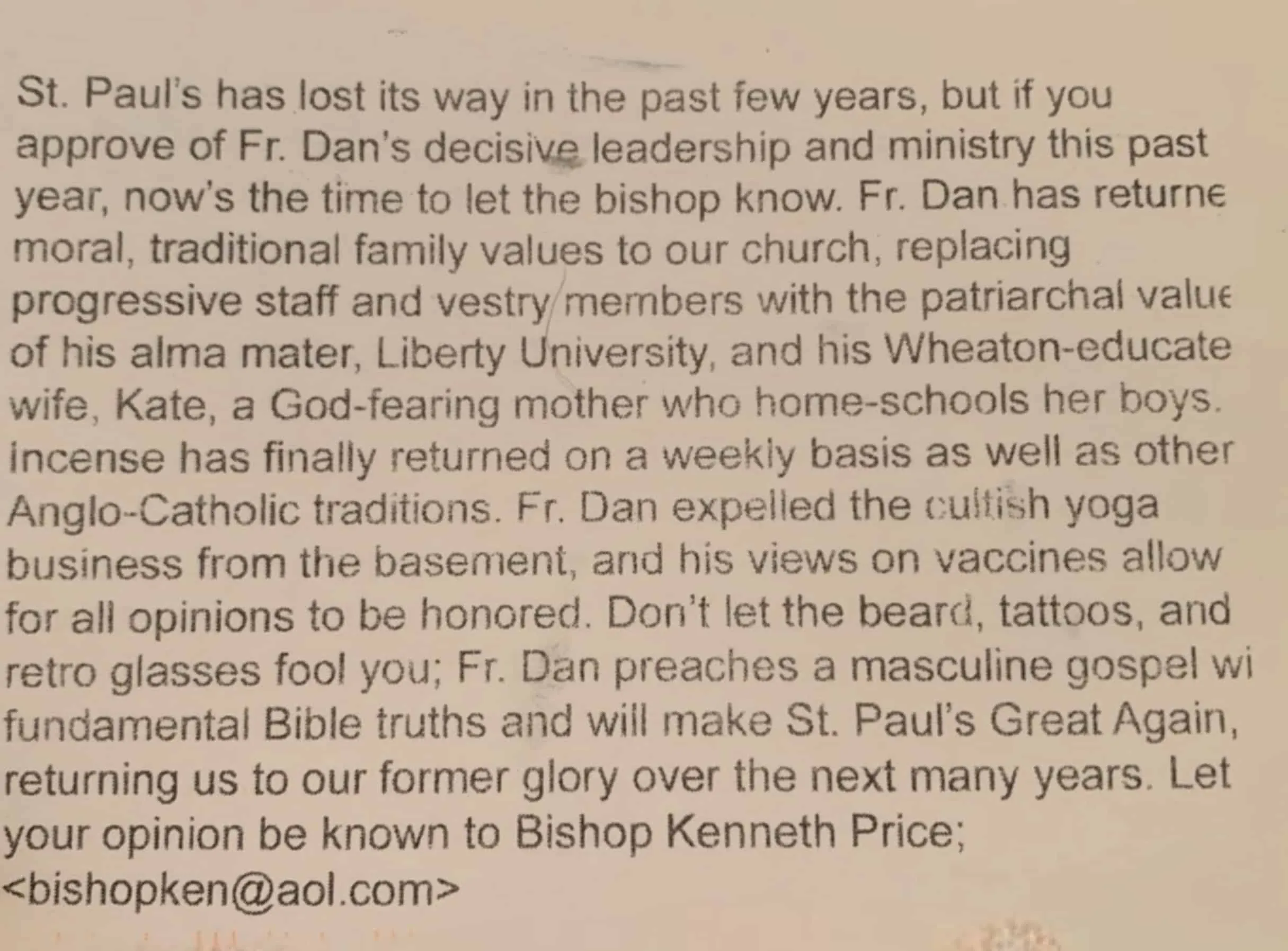 Daniel McClain’s misogynistic, “anonymous” postcard, which miraculously got sent to the entire St. Paul’s parish mailing list. Gotta love those “moral, traditional family values,” which apparently include adultery. As for his “masculine gospel,” real men don’t bully others. And we hate to break it to him: Clergy do not get to “replace” vestry members based on whether they are viewed as progressive, versus patriarchal.
 - His obsession with how others see him.
- His questionable financial expenditures, including allegedly having St. Paul’s unknowingly pay for his adulterous partner to travel with him to England. To be clear:We are confident that not even the most indulgent vestry member or parishioner wants to pay for McClain’s paramour to travel with him on the church’s dime, especially when McClain didn’t see the need to clear it with the church. Indeed, McClain had a fiduciary obligation to protect and preserve the church’s assets, which by definition precludes spending church money to indulge his adulterous relationship.
- His narcissistic rages when challenged.
- His petty and childish retribution when he is unhappy with someone.
- His lies and manipulation, which he deploys to justify his own behavior.
Thus, the very fact that this case is up on appeal serves primarily to underscore the fact that McClain is, indeed, a bad actor.
Moreover, we are confident that McClain understands that, regardless of his claim that his wife Kate “abandoned” him, adultery was not an acceptable outcome. In fact, if he doesn’t understand that, it’s all the more evidence that McClain is unsuited for the priesthood.
In other words, McClain’s appeal can best be seen as nothing more than an effort to “drive up the cost” of tossing him out on his sketch backside.
His attorney’s arguments underscore the fact that McClain knows he’s in the wrong
In the practice of law, there’s an old saying:
If the facts aren’t on your side, argue the law.
If the law isn’t on your side, argue the facts.
If both the facts and the law aren’t on your side, make a hell of a commotion and hope for the best.
In McClain’s case, we see his attorney taking the shotgun approach: Make a hell of a commotion, shoot in all directions, and hope something sticks.
Specifics:
1. McClain’s attorney argues that the church has said mean things about him on social media and has therefore “not respected his dignity.”
This one takes some real chutzpah. First, pretty much the only entity that has said negative things about McClain is this publication. And to be clear: No one put us up to it. We call ‘em like we see ‘em, and people are welcome to agree or disagree with us. Thus, claiming that we are somehow the church is facially illogical, and we seriously doubt that anyone in TEC is going to claim us as acting on their behalf anytime soon.
(In most cases, we’d be seriously offended if they did. Plus, we’re about as welcome in most Episcopal churches as a skunk at a wedding party, and that suits us just fine.)
Second, Title IV is about one issue, and one issue only: The behavior of clergy
In other words, “you do too” went out in second grade. It’s not a legitimate Title IV argument. No matter how evil McClain may think people at Anglican Watch are, it’s irrelevant. The only relevant issue is his conduct.
2. The bit about how McClain sought out “healthy companionship” is horses***, world without end, amen.
If McClain felt he needed help, we have no doubt his bishop would have been happy to provide resources. That’s not what he did, and it is undisputed that McClain met his future wife a) while still married and b) via a dating app.
Further, we’re going to spot McClain and his attorney a tip: Adultery is NOT healthy. It’s contrary to McClain’s ordination vows, and it is unacceptable.
Indeed, adultery is the most profoundly unhealthy way possible to deal with marital challenges.
Healthy approaches would include:
- Consulting with his bishop.
- Good-faith couples counseling. (McClain’s efforts in this space are the epitome of bad faith behavior.)
- Meaningful efforts to resolve challenges in the marriage.
We also reiterate our comments about Erin O’Rourke, McClain’s previous paramour who is now his wife.
While it is absolutely her prerogative to have an affair, and to date anyone she wants, we strongly believe that any relationship that begins in adultery doesn’t end well. Indeed, one need only look at McClain’s disrespectful conduct toward his first wife to have a solid understanding of who and what he is. And, as Maya Angelou famously said,
When someone shows you who they are, believe them the first time. People know themselves much better than you do. That’s why it’s important to stop expecting them to be something other than who they are.
As to McClain’s attorney’s assertion that somehow O’Rourke is “special,” spare us. The only person entitled to be regarded as “special” during the course of his marriage is McClain’s wife, Kate. Indeed, it doesn’t get more laughable than this.
Relatedly, we want to address an implicit issue in all of this: alleged misconduct by McClain’s wife, Kate.
On this score, Kate has boundary issues of her own, as we have seen firsthand. (No, we don’t care to elaborate.)
Moreover, she makes some remarkably bad decisions, including taking the kids and leaving Ohio without court permission. Self-help is invariably a bad idea in situations like this, and it never ends well.
Nor does it matter that Kate feared for her safety; there are far better ways to address those issues than engaging in parental kidnapping. And we are confident that others told Kate that taking the kids out of state was a stupid idea, and that she basically said she didn’t care.
That said, as we stated earlier, no matter how challenging Kate’s behavior may or may not have been, it’s irrelevant for purposes of Title IV. Plus, it’s important to remember that victims of domestic abuse — whether physical, emotional, spiritual, sexual, or other — often make decisions that, to us, look like bad choices. It’s just part and parcel of this space.
In other words, both McClain and his attorney are full of it. And we’re glad to know that, even as he pleads poverty when it comes to paying child and spousal support, McClain has money to pay for frivolous litigation.
So what is the role of the Court of Review?
All of this begs a simple question: What is the role of the Court of Review?
The answer to that question is simple: It’s solely to ensure that the Title IV hearing panel followed the canons.
In other words, the Court of Review can review only procedural issues at the hearing panel level and findings of fact or law that are both facially wrong AND prejudicial. That’s a high standard and one that is very difficult to meet.
As a result, the only issue properly before the Court of Review is whether there was a violation of the canons at the hearing panel level.
On that score, it is indisputable that adultery is unacceptable conduct for clergy. Thus, there is no legitimate outcome at the Court of Review that would overturn the hearing panel’s decision.
What if the Court of Review reverses and remands the hearing panel decision?
It’s also worth noting that the Court of Review cannot acquit McClain; it can only send the case back to the hearing panel.
On that score, part of us actually hopes that that the Court of Review does remand the case, even though it lacks the authority to do so.
Why is that?
It’s because, much like the long-simmering Cayce Ramey Title IV case in the Diocese of Virginia, a remand typically results in the respondent going from the frying pan into the fire.
In the Ramey case, the Court of Review foolishly remanded, largely because they felt that the Diocese of Virginia wasn’t sufficiently conciliatory towards Ramey.
To be clear, that’s horses***, as any fault on the Diocese’s part was actually that it was too conciliatory. In fact, the Diocese offered him chance after chance, even though it was abundantly clear early in the process that Ramey was playing games.
So, the Diocese wound up getting its back up, and now Ramey is facing multiple additional Title IV charges, and the Diocese is signaling that it will spare no expense to give Ramey the heave-ho. Meanwhile, Ramey appears to have run out of money to pay his attorney and is no longer participating in the Title IV process.
As a result, Ramey is about to get steamrolled, and rightly so.
Thus, in the unlikely event that the Court of Review does rule in favor of McClain, we suspect the Diocese will follow-up on charges beyond the single charge that is now at play, which is adultery. Among the issues we think will get attention will be:
- Allegations that McClain used parish resources for personal benefit.
- Assertions that McClain took his then-paramour, Erin O’Rourke, to England on his parish’s dime, without approval or disclosure. As we said earlier, even the most tolerant vestry member or parishioner is, we think, unlikely to want to spend church funds to support McClain’s adulterous relationship.
- Allegations that McClain conducted an unauthorized exorcism at St. Paul’s. And while we are well aware that there are vestigial aspects of exorcism in baptism and high-church celebrations of Mass, McClain’s efforts to conflate these issues with his exorcism ritual aren’t going to fool anyone. As in, church rubrics require the bishop’s approval before an exorcism can be performed. No exceptions, no excuses. (To be clear, we find it amusing that McClain thinks he can cast out demons despite his adulterous affair. While we don’t believe in demons, we’re pretty sure it doesn’t work that way.)
- McClain’s violation of diocesan COVID-prevention policies. To be clear: No rector has the authority to change, amend, rescind, or undo diocesan-level policies.
In other words, we’re prepared to bet that if the Court of Review remands the case, the next step will be a forensic audit of parish finances. And from where we sit, that’s both an appropriate next step and one that we strongly suspect will look even worse for McClain than his adulterous affair.
Of course, being the nasty so-and-sos that we are, we’d get lipsmacking glee out of seeing McClain’s antics exposed via a forensic audit of parish finances. Further, if an audit reveals misuse of funds (like McClain taking his paramour to England on the church’s dime), we’ll be the first to argue that the Diocese should refer the matter for criminal prosecution.
One way or another, this is gonna be good.
My partner burned dinner, so I decided to find a healthy alternative by going to a bar and hooking up.
According to McClain, that’s how things work in Patriach Land, right?