
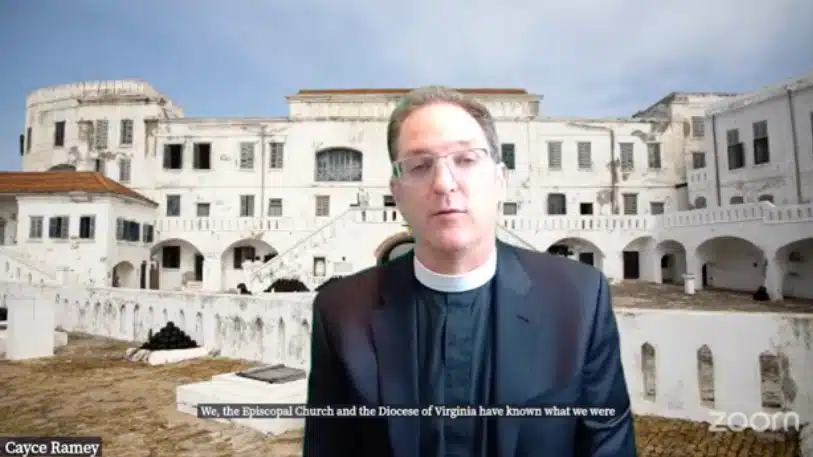
Title IV hearing panel recommends that priest Cayce Ramey be deposed, underscores shambolic handling of clergy discipline in Diocese of Virginia
Disclosure: Anglican Watch editor Eric Bonetti did not participate in the production of this post due to being a previous member of the Diocese of Virginia. He also is the complainant in a Title IV case against Episcopal priest Bob Malm, presently canonically resident in the Diocese of Virginia.
###
A Diocese of Virginia Title IV hearing panel has recommended that the Bishop Diocesan, E. Mark Stevenson, depose Episcopal priest Cayce Ramey. The outcome, while fully warranted, underscores the shambolic nature of clergy discipline in the Episcopal Diocese of Virginia.
Should Stevenson depose Ramey — and he lacks the authority to decline absent truly extraordinary circumstances — Ramey will lose the right to hold himself forth as a priest, to administer the sacraments, or otherwise function as a priest.
The Episcopal Court of Review overturned a previous hearing panel decision to depose Ramey.
The move marks the culmination of several years of Title IV clergy disciplinary proceedings, which started when Ramey began showboating and saying he wouldn’t officiate at Mass until the Episcopal Church repents of its racism. As part of his effort, Ramey launched a consulting service, “Racial Heresy,” which purports to teach people how to end racism.
Ramey’s conduct resulted in Bishop Susan Goff, then the Ecclesiastical Authority for the Diocese, urging Ramey to consider whether it is even possible to serve as a priest when, as here, the priest is unwilling to say or partake of Mass.
But rather than heeding Goff’s entreaties, Ramey doubled down, including by urging prospective clients to “hire a heretic,” on the basis that the Episcopal Church had purportedly accused him of heresy over his views on race relations. To be clear: This never happened.
In other words, Ramey’s whole modus operandi was to see if he could credential himself as an anti-racism consultant by drawing the Diocese of Virginia into a Title IV spat.
Where the Diocese flubbed things
Unfortunately, the Diocese flubbed this situation, as Goff never issued a written pastoral direction saying, “Thou shalt celebrate Mass.” That’s important because, under the canons, it’s one thing to encourage introspection. It’s another thing altogether for a clergyperson to ignore a pastoral direction, which is expressly enforceable under the canons.
As a result of this oversight, the diocesan hearing panel ordered that Ramey be deposed, but the Court of Review overruled that order, rightly concluding that there is no inherent canonical obligation to celebrate Mass. That is distinct from a canonical mandate to follow the directions of one’s bishop, which may include the directive to celebrate Mass when officiating at Holy Eucharist.
Thus, the Court of Review remanded and sent the matter back to the hearing panel, accompanied by some unfortunate and wrong-headed dicta about how the Diocese hadn’t tried hard enough to reconcile with Ramey. (For the record, the Diocese has numerous faults, but being patient with Ramey was not one of them. Indeed, the Diocese appears to have empowered Ramey’s misconduct via its deferential approach to these issues.)
The Diocese regroups
The second time around, though, the Diocese got its act together.
Not only did the Diocese discover that Ramey was violating the restrictions on his ministry imposed by the Diocese by wandering around General Convention in clericals and holding himself forth as a priest (resulting in an amended Title IV complaint), but it had, in the meantime, issued a written pastoral direction to Ramey, telling him to celebrate Mass or else.
Additionally, Ramey no-called and no-showed for a meeting with Stevenson and, beginning about a year ago, stopped participating in the Title IV process altogether. The latter is a per se violation of Title IV, which creates an affirmative obligation for clergy to cooperate in Title IV proceedings. And Ramey’s lack of basic courtesy, while not actionable under Title IV, undoubtedly did little to calm the waters.
Predictably, the Hearing Panel ruled against Ramey, and we see no possibility of an appeal to the Court of Review, since Ramey chose not to participate in the hearing panel process, despite myriad warnings from the hearing panel that it was about to lower the boom on him.
Why this matters: Ramey underscores the shambolic nature of clergy discipline in Virginia
Parsing this situation is difficult, as there were lots of things going on behind the scenes with Ramey, including intimations of mental illness on his part. That said, we think it’s worth unpacking this situation. Indeed, the fact that Ramey is getting his walking papers, while Jonathan “Johnny Boy” Adams, an alleged pedophile, is still around, sends a powerful message about clergy discipline in the diocese.
So, where to begin?
On the one hand, Ramey is unsuited to ministry. Whether it’s his silly hoo-ha about previously being a Marine and his empty babble about “battlefield promotions,” his nonsense about hiring a heretic, or his disrespect for his bishop and the people he claims to serve by playing games with Mass, this guy is a hot mess. We can go on, but you get the idea.
On the other hand, Ramey is quite right when he laments racism in the church. Not only does the church remain solidly racist (and misogynistic, homophobic, and ageist, among others), but it likes to hide these issues behind a narcissistic veneer of progressivism. As in, “We’re the Episcopal Church, so we can’t be any of these things.” That’s doubly dangerous because this paradigm makes it that much harder to resolve the challenges facing the church. (If you saw some of the hate mail we get from faithful Episcopalians, you’d know exactly what we mean. But hey, all are welcome.)
That said, Ramey’s conduct does nothing to solve any of these issues. Indeed, his efforts to profit from the suffering of others, with his feel-good “pilgrimages” to Ghana through his consulting service, only make things worse. And, to be clear: We have an ethical issue with transactional, feel-good solutions to racism.
Speaking of: This is a guy who thinks “celebratory” meals are an appropriate part of these pilgrimages. We were not aware that there was anything celebratory about slavery. (While he’s at it, he’ll probably rent you a plantation, too, so you can celebrate your wedding in true Southern style. In fact, you can learn about slavery while you’re there.)
At the same time, the Diocese hardly comes out of this looking good.
Specifically, the hundreds of hours spent dealing with this narcissistic buffoon are galling when seen in light of the Diocese’s lackluster response to Jonathan Adams, the alleged pedophile at Trinity Upperville.
Indeed, the Diocese doesn’t even appear to have insisted that “Johnny Boy” Adams tell the truth—even now, he claims in writing that he didn’t do anything wrong involving children, despite a police investigation that concluded that he was grooming boys for sex. Moreover, multiple independent witnesses corroborate these allegations.
On this score, we want to be absolutely clear: A priest who lies to his parish commits a grave sin. Clergy are called upon to mediate Christ to the church, but one cannot do so when one engages in abuse and then lies about it. Such behavior is actionable under the canons per the Title IV proscription against conduct unbecoming, and should, at a minimum, result in an extended suspension.
And yet the best the Diocese can do is to tell Adams he can’t be alone with children? That was already a diocesan policy, so we are not sure what’s changed or how this helps. Doesn’t seem to have made much difference so far.
Needless to say, we are greatly troubled by the juxtaposition of these two cases. Indeed, a priest who is allegedly grooming boys is like playing Russian roulette — sooner or later, it ends badly. And setting up rules doesn’t affect the outcome.
In short, it’s difficult to conclude that the Ramey case isn’t de facto a case of lèse-majesté, or punishing an affront to the dignity of the bishop, versus addressing real misconduct.
If nothing else, if Ramey can be deposed, it logically follows that the far more serious offense of allegedly grooming boys for sex should warrant removal from ministry.
That said, we are glad Ramey is gone. We just wish the Diocese of Virginia were more rational/consistent in its handling of clergy disciplinary complaints and more willing to protect members from the predations of persons we believe to be true sociopaths.
In the meantime, Anglican Watch is trying to make clear the seriousness of grooming by pushing for Virginia legislation that would, as in 20 other states, make grooming a criminal offense. At least that would prevent the Diocese from brushing off complaints of grooming by saying, “Well, nothing illegal happened.”
To be clear: We suspect the Diocese doesn’t fully understand that grooming is, itself, a form of abuse, with the potential for causing lasting trauma. And the people with whom we are in conversation are experiencing a lot of trauma. (That raises an important point: In all the hue and commotion about Johnny Boy, no one seems to give a red rat’s rear end about the victims of his alleged behavior. Which is pretty damned sad, coming as it does from a church.)
In that regard, both Ramey’s behavior and that of “Johnny Boy” Adams are forms of abuse. The challenge is that the Diocese, like much of the Episcopal Church, doesn’t take spiritual or emotional abuse as seriously as it takes sexual misconduct. (Stuck in the Madmen era, anyone?)
We also want to be clear: As harsh as we sometimes sound towards the Diocese of Virginia, we want to see both the Diocese and the larger church succeed. But having either Ramey or “Johnny Boy” Adams as a priest is the very antithesis of success.
A copy of the hearing panel’s order follows.
I knew Ramey when he was in Alexandria. Spectacularly unimpressive. No surprise at all that it has come to this.