
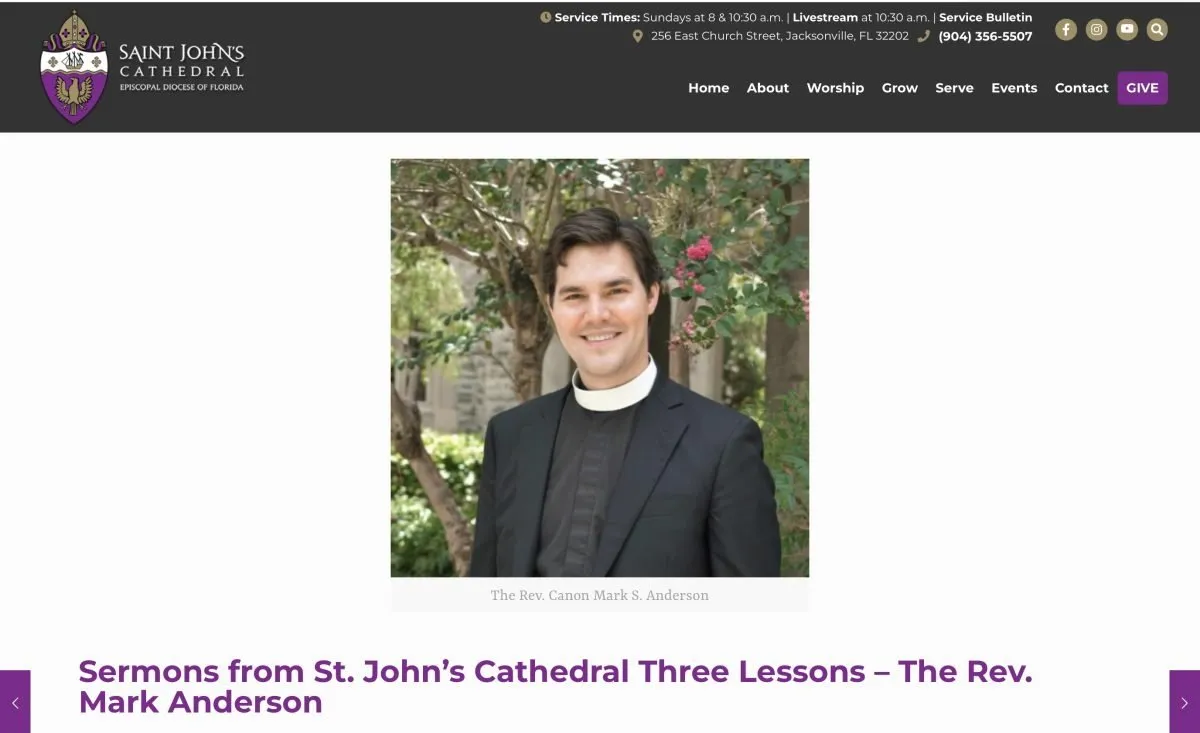
Anglican Watch editor Eric Bonetti files motion opposing Episcopal priest Mark Anderson’s motion to seal divorce proceedings
One thing church abuse bloggers quickly learn is that any effort within a faith community to operate without scrutiny is never a good sign. And so it is in Episcopal priest Mark Anderson’s divorce litigation, where he has filed a motion to seal just about everything in the case. In response, Anglican Watch editor Eric Bonetti has, on his own behalf, filed a limited appearance to appear pro se in opposition to Anderson’s motion.
At the heart of the matter is the public’s right to know about issues involving Anderson’s suitability to be an Episcopal priest. Additionally, American jurisprudence has long recognized that our courts operate best when proceedings are open to the public. This is also a First Amendment issue, as free speech comprises not just the right to communicate, but also to receive communications from others.
In Anderson’s case, his pleadings raise several issues that we discussed previously, including:
- His self-professed committed relationship with a woman who is not his wife, even though he remains legally married.
- His potential tax fraud by claiming almost his entire salary as a housing allowance, even though he does not appear to live in the residence in question.
- His inconsistent statements, made under oath, about the roughly $1 million gift from his father. For purposes of getting a mortgage, Anderson stated, under penalty of perjury, that the funds were a gift. Now, for purposes of his divorce, he claims they were a loan, and his wife should help repay it —even though he’s produced no evidence that she ever agreed to any such loan.
Thus, while we rarely wade into divorce proceedings involving clergy, Anderson’s pleadings implicate issues of his personal and professional integrity and questions of mission integrity for the church.
Tellingly, it appears that Anderson recognizes potential issues with his behavior, as one of the questions certified to the court during discovery involved questions about intimate behavior between Anderson and his girlfriend, even while still married to his wife. As in, if there were no issue of potential church discipline, why would he care?
Anderson also omits a salient fact, which is that we’ve been careful to omit information involving the child from his marriage and other protected information.
Meanwhile, we are deeply concerned about the conduct of Anderson’s attorneys, who appear to be coming dangerously close to trying to perpetrate a fraud upon the courts.
Specifically, Anderson tries to sidestep inconsistencies in his mortgage application and divorce proceedings — even though there is evidence that he and his father may have collaborated to convince the court that the $1 million gift toward the house down payment was a loan. This conduct appears to contradict disciplinary rule 3.3’s duty of candor to the tribunal, which requires attorneys to refuse to offer testimony reasonably known to be false. And we are confident that Anderson’s attorneys realize that the $1 million cannot simultaneously be a gift for purposes of a mortgage, but a loan for purposes of a divorce.
There’s another reason we believe the public should see Anderson’s legal tactics firsthand: his fabrication that this publication has somehow defamed him. Indeed, there is nothing defamatory about pointing out the inconsistencies in his various sworn statements. And while statements made in the course of litigation are per se privileged, any law student who’s completed first-year torts class knows that this claim is false—and would likely be defamatory itself if made outside the context of a civil proceeding.
Thus, the public has the right to know that this is the sort of behavior in which Anderson engages. Moreover, they can evaluate such conduct in light of the standard of clergy behavior articulated in the canons:
This Title applies to Members of the Clergy, who have by their vows at ordination accepted additional responsibilities and accountabilities for doctrine, discipline, worship and obedience. (Canon IV.1)
Meanwhile, Rocket Mortage, Anderson’s previous mortgage lender, has acknowledged receipt of the information we provided to the company about Anderson’s inconsistent information about the gift from his father. Relatedly, the Diocese of Florida has acknowledged receipt of our Title IV complaint against Anderson.
Below is a copy of Bonetti’s motion, which was accepted by the Florida court earlier today.
Those who want to learn more about an attorney’s obligation to disclose untruthful information to the courts may find the following document, published by the Florida Bar, helpful: